
Running a small business means managing customers, sales, operations, and many other daily tasks. Marketing can easily become another challenge. This is where digital marketing for small businesses can help.
You do not need to be active on every platform or spend a large amount on advertising. The key is to choose the right channels, understand your audience, and consistently reach people who are likely to become customers.
In 2026, customers may discover a business through Google Search, Maps, social media, websites, online ads, email, or AI-powered search experiences. This guide explains practical digital marketing strategies that small businesses can use with a realistic budget.
What Is Digital Marketing for Small Businesses?
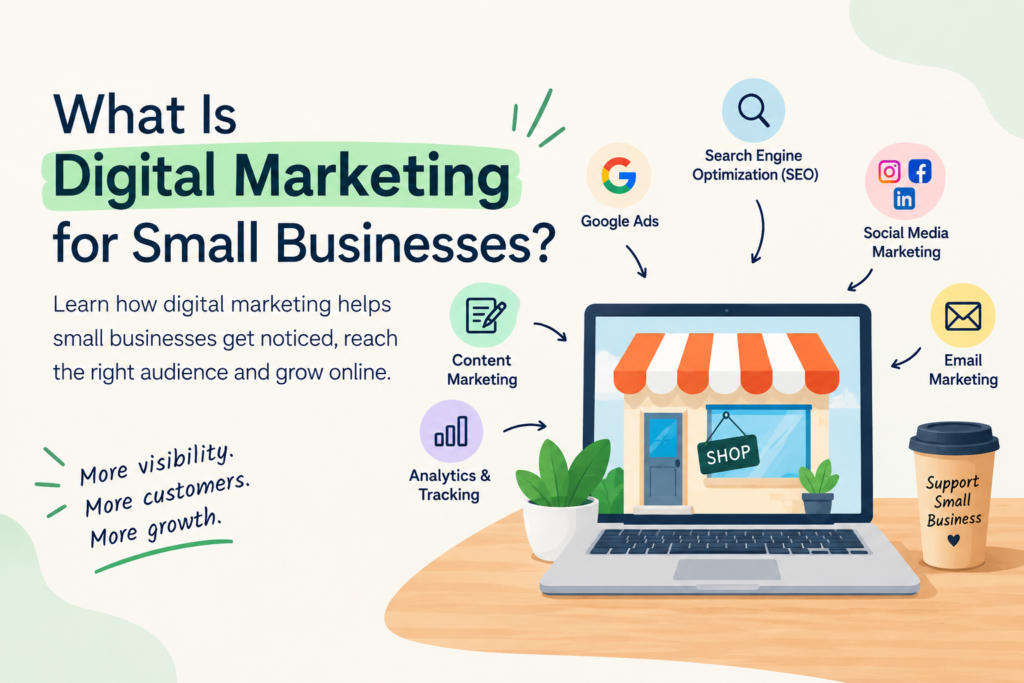
Digital marketing means promoting a business through online channels such as search engines, websites, social media, email, content, and paid advertising.
For a small business, the goal is simple: help the right people discover your business, understand what you offer, trust your brand, and take action.
For example, a salon in Bengaluru might be discovered through a Google search. A customer could then visit its website, check Instagram, read reviews, and contact the salon through WhatsApp before booking an appointment.
Compared with traditional marketing, digital marketing also makes it easier to track activities such as website visits, clicks, leads, and conversions.
Why Digital Marketing Matters for Small Businesses in 2026
A strong online presence can help small businesses:
Improve online visibility through search engines and social platforms.
Reach the right audience based on location, interests, search intent, and other factors.
Build trust through websites, reviews, content, and customer experiences.
Generate leads through forms, calls, messages, bookings, or purchases.
Increase website traffic through SEO and useful content.
Measure performance using marketing and analytics data.
Compete with larger businesses by focusing on specific audiences and locations.
The goal is not simply to get more views. It is to connect marketing activity with real business outcomes.
7 Digital Marketing Strategies for Small Businesses
You do not need to implement every strategy at once. Start with the channels that make sense for your customers.
1. Build a Strong Business Website
Your website is often the central point of your online presence.
It should clearly explain:
What you offer
Who you serve
Where you operate
Why customers should choose you
How customers can contact or buy from you
A good website should be mobile-friendly, fast, easy to navigate, secure, and designed around clear calls to action.
For example, an interior designer could have separate pages for residential interiors, commercial projects, services, locations, previous work, and enquiries.
Your website should not only look professional. It should help visitors take the next step.
2. Invest in SEO and Local SEO
SEO helps your website appear when people search for information, products, or services related to your business.
Basic SEO activities include:
Keyword research
Optimized titles and headings
Useful website content
Internal linking
Technical SEO
Image optimization
Quality backlinks
For businesses serving a specific area, local SEO for small businesses is especially important.
Maintain an accurate Google Business Profile, add relevant business information and photos, collect genuine reviews, and keep your website details consistent.
Google says local search results are mainly influenced by relevance, distance, and prominence.
For example, a dentist in Bengaluru should focus on relevant searches such as “dentist near me” or “dentist in [location]” rather than trying to target extremely broad searches.
3. Use Social Media Marketing
Social media marketing for small businesses works better when you choose platforms based on your audience.
Instead of trying to maintain every platform, ask:
Where does my target customer actually spend time?
Depending on your business, this could be Instagram, Facebook, LinkedIn, or YouTube.
Content ideas include:
Educational posts
Short videos
Product demonstrations
Customer questions
Behind-the-scenes content
Testimonials
FAQs
Offers
Consistency matters, but posting every day is not always necessary. Useful content and genuine audience interaction are more important than simply increasing your posting frequency.
4. Create Helpful Content
Content marketing for small businesses is about answering customer questions and solving problems.
You can create:
Blog posts
Reels
Videos
Guides
FAQs
Tutorials
Product comparisons
Educational posts
Customer stories
For example, a skincare business could create content about choosing products, understanding ingredients, or building a simple skincare routine.
Helpful content can build trust while also creating more opportunities to appear in relevant searches.
5. Use Google Ads Strategically
Google Ads can help businesses reach people who are actively searching for specific products or services.
For example, someone searching for “AC repair near me” already has a clear need. A relevant advertisement can put a business in front of that potential customer.
However, successful advertising requires more than simply running an ad.
Pay attention to:
Search intent
Keyword targeting
Location targeting
Ad copy
Landing page relevance
Budget
Conversion tracking
Start with focused campaigns and a controlled budget. If you receive clicks but no enquiries, check the targeting, offer, landing page, and conversion process before increasing your spending.
6. Use Email and WhatsApp Marketing Responsibly
Email and WhatsApp can help businesses stay connected with existing customers and leads when used with appropriate permission.
Businesses can use them for:
Offers
Product updates
Appointment reminders
Follow-ups
Helpful information
Repeat purchases
Avoid sending too many promotional messages. Useful and timely communication is more effective than constant sales messages.
7. Track Results and Improve
You do not need to understand every analytics metric. Start with numbers that connect directly to your business goals.
Traffic: How many people visit your website?
CTR: How many people click after seeing your search result or advertisement?
CPC: How much does each advertising click cost?
Conversion rate: What percentage of visitors take the desired action?
CPL: How much does it cost to generate one lead?
ROAS: How much revenue is generated compared with advertising spend?
For example, if 100 people visit your website and 5 submit an enquiry, your conversion rate is 5%.
Use this information to identify what is working and what needs improvement.
How to Create a Digital Marketing Plan for a Small Business
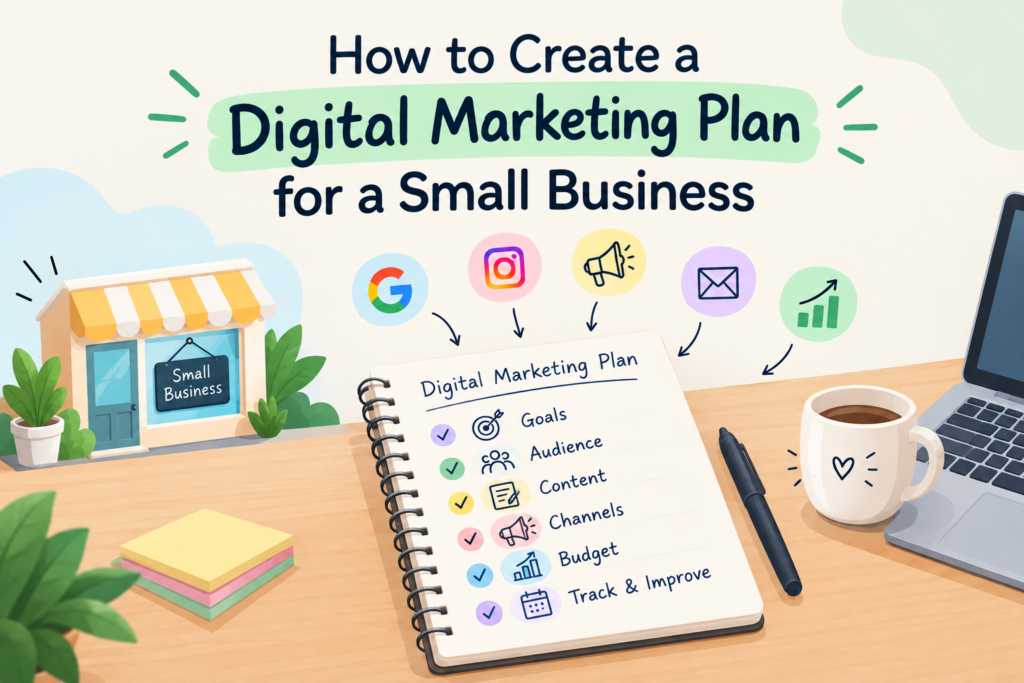
A simple plan is better than randomly trying different marketing activities.
1. Define the Business Goal
Decide what you want to achieve, such as more leads, sales, bookings, website traffic, or local customers.
2. Identify Your Target Audience
Understand their location, needs, problems, budget, and buying behaviour.
3. Choose the Right Channels
A local service business may focus on SEO, Google Business Profile, Google Ads, and WhatsApp, while an e-commerce brand may need SEO, social media, email, content, and paid advertising. https://bhumikasrinivas.com/what-is-seo-in-digital-marketing/
4. Create a Content Plan
Plan content around customer questions, problems, products, services, testimonials, and useful information.
5. Set a Realistic Budget
Separate your organic activities from paid advertising. Start small and increase spending when you have evidence that a channel is producing results.
6. Launch and Track
Launch your campaigns and monitor traffic, leads, conversions, and costs.
7. Improve Based on Data
Keep what works, test improvements, and reduce effort on activities that are not contributing to your goals.
Digital Marketing Budget for Small Businesses
There is no fixed budget that works for every business.
A restaurant, local service provider, consultant, and e-commerce store can have very different marketing requirements.
Instead of asking only how much to spend, consider:
What is one customer worth to my business?
How many customers do I need?
Which channels can reach them?
What budget can I sustain?
What result would make the investment worthwhile?
Businesses can begin with organic activities such as SEO, local SEO, social media, and content marketing. Paid advertising can then be tested with a controlled budget.
The objective is not to spend more. It is to understand what produces useful business results and scale carefully.
Common Digital Marketing Mistakes Small Businesses Should Avoid Trying Every Platform at Once
Focus on the channels your customers actually use instead of trying to maintain every social platform.
Ignoring SEO
A website without a search strategy can miss customers who are actively looking for your products or services.
Posting Without a Strategy
Random posts may create activity without generating meaningful results. Connect your content to customer needs and business goals.
Targeting Everyone
A broad audience often leads to generic messaging. Be specific about who you want to reach.
Focusing Only on Followers
Followers can be useful, but leads, sales, bookings, and customer retention are often more important business metrics.
Not Tracking Conversions
Do not stop at likes and website visits. Track actions that contribute to your business goals.
Expecting Instant Results
SEO and organic content usually require consistency and time. Paid advertising can generate traffic faster, but campaigns still need testing and optimization.
Copying Competitors
Competitor research can provide ideas, but your strategy should be based on your own customers and business goals.
Digital Marketing Trends Small Businesses Should Watch in 2026
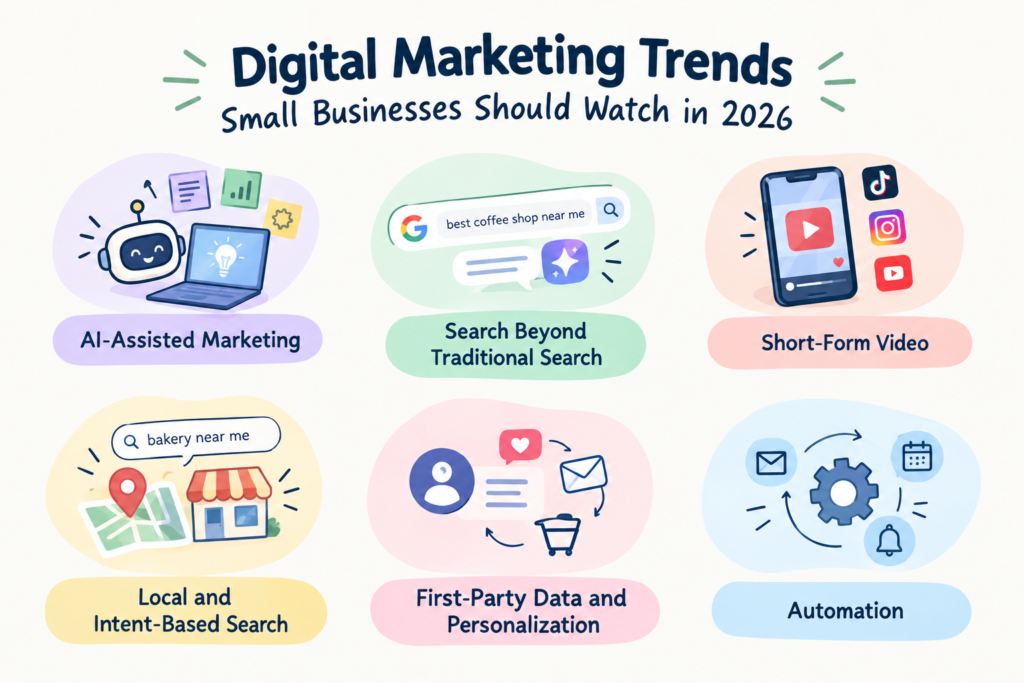
Some developments are established practices, while others are still emerging.
AI-Assisted Marketing
AI tools can help with research, content ideas, analysis, repetitive tasks, and marketing workflows. Human review is still important for accuracy, originality, and brand voice.
Search Beyond Traditional Search
Search is becoming more conversational and AI-assisted. Google continues to expand AI-powered search experiences, making useful and trustworthy content increasingly important.
Short-Form Video
Short videos can help businesses demonstrate products, answer FAQs, explain services, and introduce the people behind the brand.
Local and Intent-Based Search
Specific searches such as “best bakery near me” or “digital marketing agency in Bengaluru” show stronger intent than very broad searches. Local SEO and relevant business information can therefore be valuable for location-based businesses.
First-Party Data and Personalization
Email subscribers, customer information collected with appropriate consent, and purchase history can help businesses build direct customer relationships and create more relevant communication.
Automation
Automation can simplify repetitive tasks such as lead notifications, appointment reminders, email sequences, and reporting.
How to Choose the Right Digital Marketing Strategy for Your Business
The right strategy depends on your:
Business goal
Target audience
Budget
Industry
Location
Customer journey
For example, a local salon may focus on Google Business Profile, local SEO, Instagram, reviews, and WhatsApp.
A B2B consultant may focus more on LinkedIn, SEO, content, email, and lead generation.
An e-commerce business may combine SEO, social media, email, product content, and paid advertising.
The important thing is to choose channels that connect your business with the right customers instead of trying to do everything.
Digital marketing for small businesses does not require a huge budget or a presence on every platform.
Start with the basics: build a useful website, improve your search visibility, understand your audience, create helpful content, use social media intentionally, test paid advertising where appropriate, and track your results.
You can start with two or three focused strategies and expand as your business grows. Consistency, measurement, and continuous improvement are more valuable than trying every new marketing trend.
If you want to improve your online visibility, reach the right audience, and build a practical marketing strategy, an AI Digital Marketing Agency approach can bring together SEO, social media, content, advertising, websites, and automation.
Explore my digital marketing services at bhumikasrinivas.com or get in touch to discuss a strategy suited to your business.