
What is SEO in digital marketing
If you’re trying to understand what is SEO in digital marketing, you’re already on the right path. Every time you search for something on Google and click on one of the top results, have you ever wondered why that page appears first?
The answer lies in how Google ranks and displays content. What you see on the first page is not random; it’s the result of careful and right optimization, strategy, and relevance. In today’s digital space, just creating a website or publishing content is no longer enough. Millions of websites are competing for attention, with new content being added every second.
Without proper visibility, even high-quality content can go unnoticed. That’s exactly where SEO becomes important. SEO helps your website reach people who are actively searching for what you offer. It transforms search engines into a powerful and consistent source of organic traffic, allowing you to attract the right audience, build trust, and grow your online presence over time.
What Does SEO Actually Do for a Website
Let’s break SEO down in a simple way. Think about the last time you searched for something like “best phones” or “how to lose weight.” Within seconds, you saw a list of results on Google. But why did those specific pages show up first? That’s where SEO (Search Engine Optimization) comes in.
SEO is the process of improving your website so it appears higher in search results, but it’s not just about ranking—it’s about being relevant. Search engines go through thousands of pages to find the most relevant answers for a query asked by users, and SEO helps your content become one of those answers.It works by aligning your website with what people are actually searching for.
When your content uses the right keywords, provides helpful information, and offers a smooth and great user experience, search engines are more likely to show it to users. The most important thing to understand is that modern SEO isn’t about tricking search engines. It’s about helping people. When your content genuinely adds value and answers real questions, higher rankings naturally follow.
Why SEO matters in digital marketing
Imagine you’ve created a great website or written an amazing blog, but people are not able to find. That’s exactly the problem SEO solves. It helps your content appear in front of people who are already searching for it.
When someone types a query into Google, they usually trust the first few results they see. SEO helps your website stand out in search results, increasing your chances of getting clicks without paying for ads.
Over time, this builds a steady flow of organic traffic that keeps growing. But it’s not just about traffic. SEO also builds trust. When your website shows up consistently in search results, people start seeing it as reliable and relevant. At the same time, SEO improves your website experience, making it faster, mobile- friendly, and easier to navigate.
In a way, SEO is like a bridge. It connects your content with the people who are already searching for it, making your online presence stronger and more visible to the users.
How SEO works
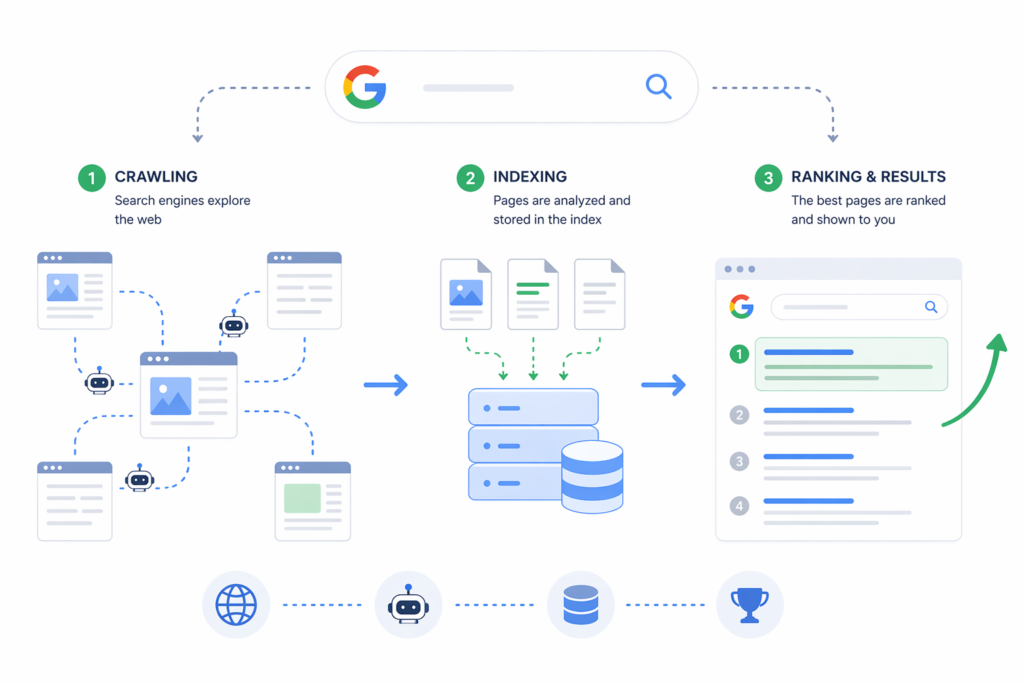
SEO might sound technical, but the idea behind it is quite simple. Search engines like Google are constantly scanning the internet to find and organize content. They do this through crawling, indexing, and ranking. First, search engines discover your website by “crawling” it using bots. Then, they store your content in their database, which is called indexing.
Finally, when someone searches for something, Google goes through its index and ranks pages based on how relevant and useful they are.This is where SEO comes in. By using the right keywords, creating helpful content, and making your website easy to use, you’re giving search engines clear signals about what your page is about.
The better these signals are, the higher your website ranks. So instead of trying to “trick” search engines, SEO is really about helping them understand your content and making sure it genuinely helps the user who are looking for information or a solution.
What is SEO in digital marketing with examples
By now, you have understood that SEO helps your website become more visible when searched. But have you wondered what it actually looks like in real life? Let’s take a simple example. Imagine you have a blog about fitness, and you write an article on “home workouts for beginners”. When someone searches for that exact phrase on Google, your goal is to appear in those results.
If your content is clear, helpful, and optimised with the right keywords, your page has a higher chance of showing up—bringing visitors to your website without any paid ads. Now think about a small business. If you are running an online store that sells handmade candles. When someone searches for “buy scented candles online”, SEO helps your product page appear in search results.
This increases your chances of getting clicks and customers organically. Even service-based businesses use SEO.
For example, if a digital marketing agency optimizes its website for keywords like “SEO services for small businesses”, it can attract clients who are actively looking for those services. In all these cases, the idea is the same.
SEO connects your content, products, or services with people who are already searching for them. Instead of interrupting users with ads, it meets them exactly where their interest already exists. That’s what makes SEO so powerful; it doesn’t just bring traffic; it brings the right traffic.
How do search engines work
Every time you type something into Google, it feels almost magical. Within seconds, you get a list of answers that seem exactly what you were looking for. But behind that search bar, there’s a system working nonstop.
Search engines are constantly exploring the internet, almost like curious explorers. They move from one page to another, discovering new content, checking updates, and understanding what each page is about. Once they find a page, they analyze it. They look at the content, the words used, how the page is structured, and even how easy it is to use.
Now comes the interesting part. When you search for something, the search engine doesn’t pick results randomly. It tries to match your query with the most relevant and helpful pages it has already stored. It checks if the page is answering user’s question, trustworthy and easy to read. Based on these signals, it arranges the results in order—showing you what it thinks will help you the most.
Search engines are constantly learning and improving to give better answers. In simple terms, search engines work by exploring, understanding, and delivering the best possible content.
How does Google order and rank search results?
The moment you hit “search”, the ranking process begins behind the scenes. In less than a second, Google is already working to answer one simple question: “What is the best result for this person right now?” But here is the interesting part; it’s not just matching words. It’s trying to understand you.
Let’s say you search for “best phones online”. Are you looking for a list? Reviews? Or ready to buy one? Google tries to figure out your intent first. Once it understands that, it starts filtering through different pages to find the ones that fit your needs or query the best.
Now imagine Google going through each page and asking the following: Does this actually answer the question? Is it helpful? Can the user trust it?Pages that clearly explain things, solve problems, and provide real value naturally move higher.
On the other hand, content that feels confusing, outdated, or unhelpful gets pushed down. But that’s not all. Google also looks at what others think about your content. If other websites link to your page, it’s like getting recommendations from that website. The more quality “votes” you have, the more trustworthy your page appears.
Then comes the user experience. If your website loads slowly or is hard to use on a phone, people leave, and Google notices that. A fast, smooth, and mobile-friendly website always has a high chance to rank better. It’s not about tricks or shortcuts. Google combines all these signals to decide which pages deserve to be ranked.
So, when you see a website ranking first, it’s not luck—it’s because that page did the best job at being relevant, helpful, and trustworthy for that search.
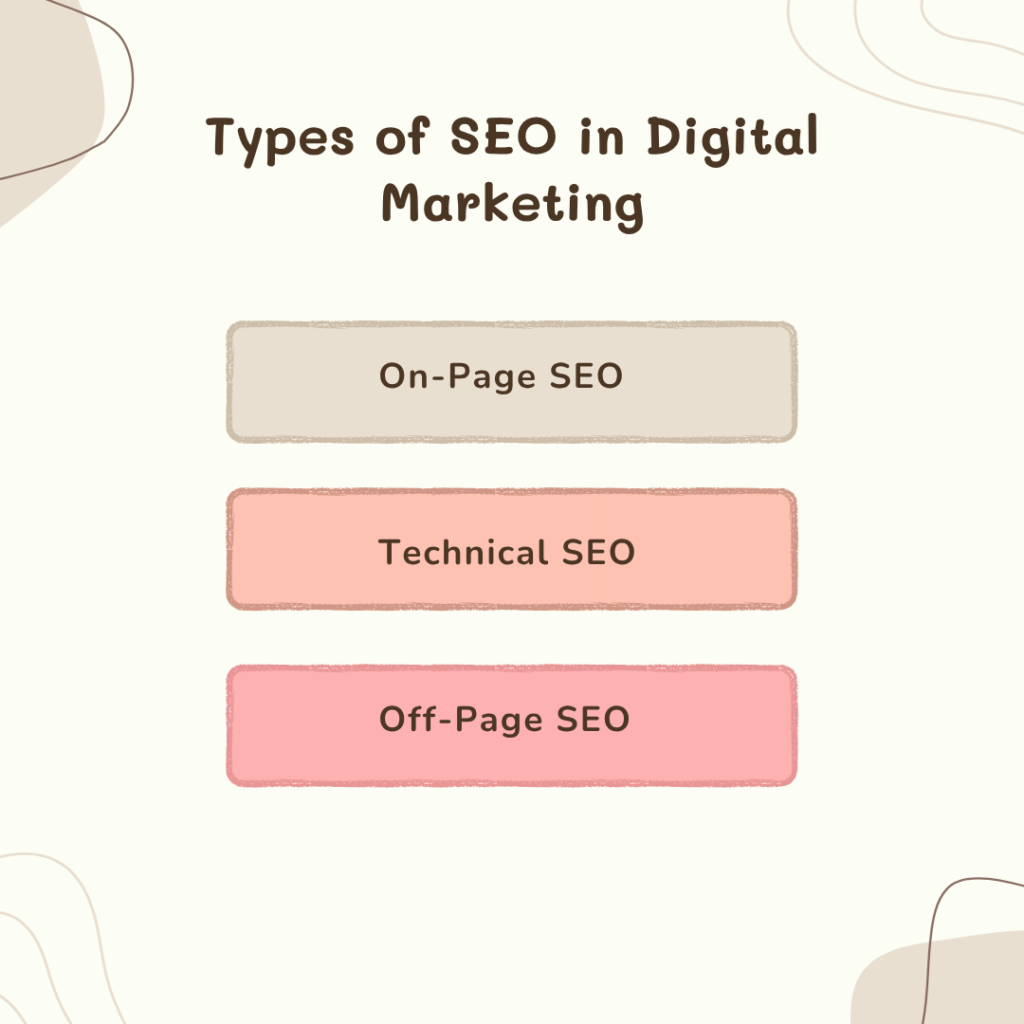
Types of SEO in Digital Marketing
When You Search Online… Why Do You Stay on One Website?
You search for something on Google, click one result, and the page opens. In a few seconds, you’ve already made a decision—stay or leave. And the strange part is, you don’t even think about it. You just feel it.
Something about the page tells you whether it’s worth staying or not. That feeling is not random. It comes from multiple layers working together in the background. That’s SEO. Not as a technical trick, but as a system that quietly decides whether people trust what they see. Let’s break it down in a simple way.
On-Page SEO:
Imagine walking into a store where everything is messy. You came looking for something specific, but nothing feels clear. You’d probably walk out immediately. Now imagine another store where everything is clean, organized, and exactly what you need is easy to find. That’s the difference on-page SEO creates.
When someone lands on your page, they don’t read—theyscan. In those first few seconds, they are trying to answer one question:
“Is this what I was looking for?”
On-page SEO is about making sure the answer is instantly yes. It’s not about stuffing keywords into sentences. It’s about understanding what the user actually wants and shaping your content around that intent. If someone is looking to learn something, your content should teach. If they are comparing options, your content should guide. If they are ready to take action, your content should help them decide.
Keywords only act as signals. They help search engines understand the context. What truly keeps users engaged is how your content flows naturally and how clearly it solves their problem. When everything is structured well, something interesting happens—the user stops thinking about SEO and just keeps reading the content.
Off-Page SEO:
Have you ever read something online and immediately thought, “This seems reliable,” even before checking the details? That trust doesn’t come from the website itself. It comes from reputation built outside of it.
Now imagine your website is mentioned by other trusted websites. Not once, but repeatedly. Each mention is like someone saying, “Yes, this is worth reading.” That’s what off-page SEO does.The most powerful part of it is backlinks. When other websites link to your content. It’s similar to recommendations in real life. If someone you trust suggests something, you’re more likely to believe it.
Search engines think the same way.
But trust isn’t built through random links. One strong recommendation from a relevant website is more powerful than many weak ones. Over time, your website starts gaining authority, not because you said it’s good, but because others proved it.
In simple terms, this is how the internet decides whether your website deserves attention.
Technical SEO:
Think about the last time a website took too long to load. What did you do? You probably didn’t wait. You left. That’s exactly why technical SEO exists. Most users never see it, but they always experience it. It controls how smoothly a website runs.
Search engines need to access your pages easily, understand how they’re connected, and store them correctly. If anything blocks that process, your visibility drops. But technical SEO isn’t just about search engines—it’s about people too.
Fast website feels better. A mobile-friendly design feels easier. A clean structure feels effortless to use. When everything works properly, users don’t notice anything at all—and that’s the goal. Because the moment something feels slow or confusing, attention is lost. Technical SEO quietly prevents that from happening.
How It All Comes Together
These three layers work like parts of one system.On-page SEO makes your content relevant and easy to understand. Off-page SEO builds authority, so people believe you. Technical SEO ensures nothing breaks the experience. When all three align, people find your content easy to read, trust it quickly and stay longer without even thinking about it.
That’s when SEO starts feeling like a natural flow between search, content, and experience.
Organic Search vs Paid Search
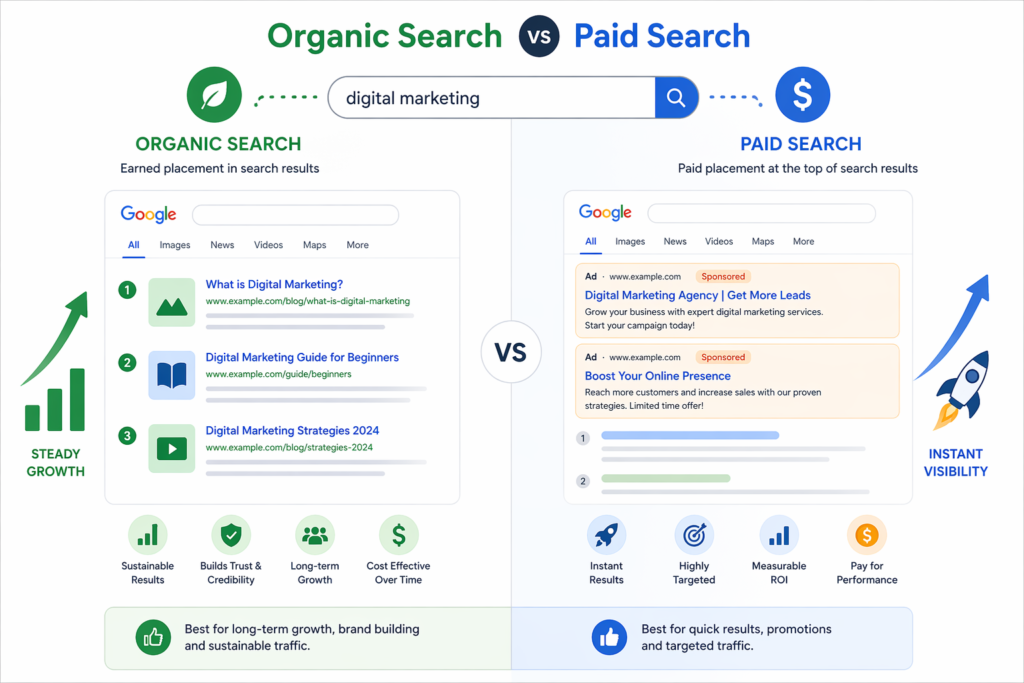
When you search for something on Google, you don’t really think about what’s happening behind the screen. You just click the result that looks most helpful and move on. But here’s something interesting—those results didn’t appear in the same way.
Some earned their place. Some paid for it. That’s the real difference between organic search and paid search. And once you understand it, you’ll start seeing Google in a completely different way.
Organic Search:
Have you ever noticed how some websites keep showing up repeatedly when you search for something? That doesn’t happen by accident. Organic search is when a website appears on Google without paying for it. It earns its position over time.
Think of it like this—imagine a person in your circle who always gives helpful advice. They don’t advertise themselves, but people naturally start trusting them. Slowly, they become the “go-to” people. That’s exactly how organic search works.
Google keeps observing how useful your content is. If people click on your page, stay on it, find value, and don’t bounce back immediately; it sends a strong signal that your content is helpful.Over time, Google starts trusting your website increasingly.
But here’s the part most people miss—it’s not instant. You build your way there through consistency, useful content, and proper optimization. And once you reach that point, something powerful happens, traffic keeps coming even when you’re not actively promoting it. That’s the long-term strength of organic search.
Paid Search:
Now imagine you don’t want to wait. You want visibility today, not months later. That’s where paid search comes in. These are the results you see at the top of Google marked as “Ad”. Instead of earning your place, you pay to be there.
Think of it like booking the best stall in a busy marketplace. You don’t wait for people to discover you—you place yourself directly in front of them. The advantage is speed. The moment your ad goes live, traffic can start coming in.
It’s perfect when you’re launching something new, promoting an offer, or targeting a very specific audience. But there’s a catch. The visibility is tied to your budget. It doesn’t build long-term ranking or authority on its own.
The Real Difference
The difference is actually very simple. Organic search is about earning attention. Paid search is about buying attention. Organic search grows slowly but stays strong for a long time. Paid search works instantly but disappears when funding stops.
One builds trust. The other buys visibility.In the real digital world, it’s not about choosing one over the other. It’s about understanding what you need. If you want quick attention, paid search works best. If you want long-term growth and trust, organic search is the foundation. And when both are used together, you get the best of both worlds—instant visibility and lasting presence.
Objectives of SEO in Digital Marketing
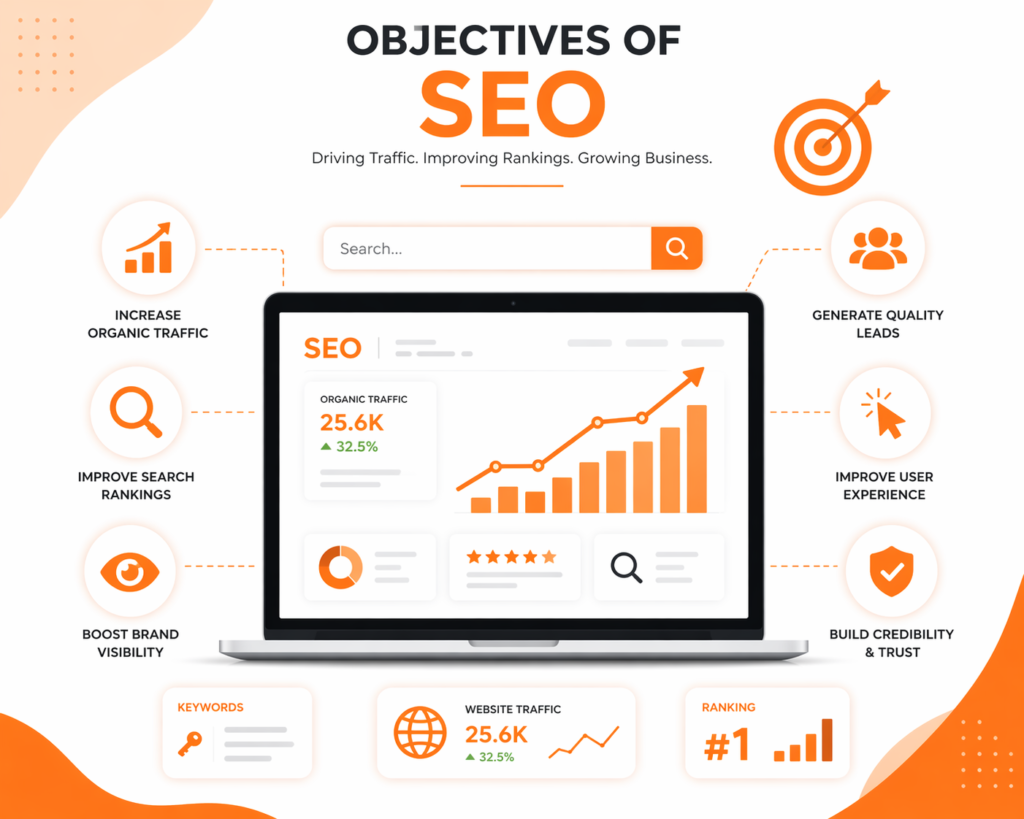
Today, people don’t randomly browse the internet. They search with clear intent. That is where SEO becomes important. It quietly decides whether your content is visible, relevant, and trusted enough to appear in front of the right audience.
SEO is not just about ranking higher. It is about connecting the right content with the right audience at the right time in a natural way.
Helping the Right Audience Find You
Every search has a purpose behind it. Some people are learning, some are comparing options, and some are ready to take action. Without SEO, even useful content can remain hidden where no one sees it. SEO helps your website appear when someone is actually searching for what you offer.
This means the traffic you get is not random but is relevant and meaningful. In simple terms, SEO ensures that right people find your content.
Visibility Without Forcing Attention
Unlike ads that interrupt users, SEO works in a more natural way. It places your content in front of people at the exact moment they are already looking for that information. This makes the visibility feel useful. When users find your page through search, they are already interested in it, which increases the chances of engagement and trust.
Long-Term Growth Instead of Temporary Traffic
One of the biggest advantages of SEO is long-term value. A well-optimized page can continue bringing traffic for months or even years without ongoing payment. This makes SEO a strong foundation for stable digital growth.
Unlike paid ads, where traffic stops when spending stops, SEO keeps working in the background once it is built properly.
Building Trust and Credibility
People naturally trust organic search results more than ads. When a website appears consistently in top results, it starts building credibility in the user’s mind. SEO helps create this trust by focusing on useful content, relevance, and good user experience. Over time, both search engines and users start seeing the website as reliable.
Better User Experience
SEO is not only for search engines—it also improves how users interact with a website. A well-optimized website loads faster, is easier to navigate, and presents information clearly. This keeps users engaged and reduces frustration. When users stay longer and interact more, it also improves rankings, creating a positive cycle.
SEO helps make content discoverable, trustworthy, and useful. It brings the right audience, builds long-term visibility, improves user experience, and
supports steady digital growth. In simple terms, SEO ensures that when people search for something, your content has a real chance to be the answer.
Conclusion
SEO is not just a digital marketing technique but the way your content earns attention in a world full of information.Every time someone searches on Google, they are not looking for “content”, they are looking for clarity, solutions, and trust. SEO helps your website become one of those trusted answers.
But here’s what really matters: SEO is not about tricks or shortcuts. It is about understanding people. When your content matches what users are searching for, when it answers their questions without confusion, and when it feels easy to read and useful in the moment—that’s when search engines start noticing you.
Over time, your website stops being just another page on the internet and starts becoming a reliable source of information. Traffic becomes more consistent, visibility becomes more stable, and trust grows naturally without forcing it.
Think of SEO like a long-term relationship with your audience. You don’t win it in a day but you build it through consistency, value, and relevance. And the more you focus on helping users, the more search engines reward you for it.
In simple terms, SEO is not about getting clicks—it’s about becoming the answer people trust. Take the next step and build content that connects better with your audience. https://mailchimp.com/marketing-glossary/seo/
FAQs
1. What are the three pillars of SEO?
SEO has three pillars: On-page SEO (content & keywords), Off-page SEO (backlinks), and Technical SEO (website structure and performance).
2. What are the best SEO strategies?
Focus on keyword research, high-quality content, on-page optimization, and building backlinks. Also, improve website speed and update content on a regular basis.
3. Which type of content is best for SEO?
Content that is high-quality, user-focused, and matches search intent works best for SEO—especially content that clearly answers questions or solves problems.
4. What is the most important thing in SEO?
The most important factor in SEO is high-quality, user-focused content. Search engines like Google rank content that provides real value to users.