
What is digital marketing
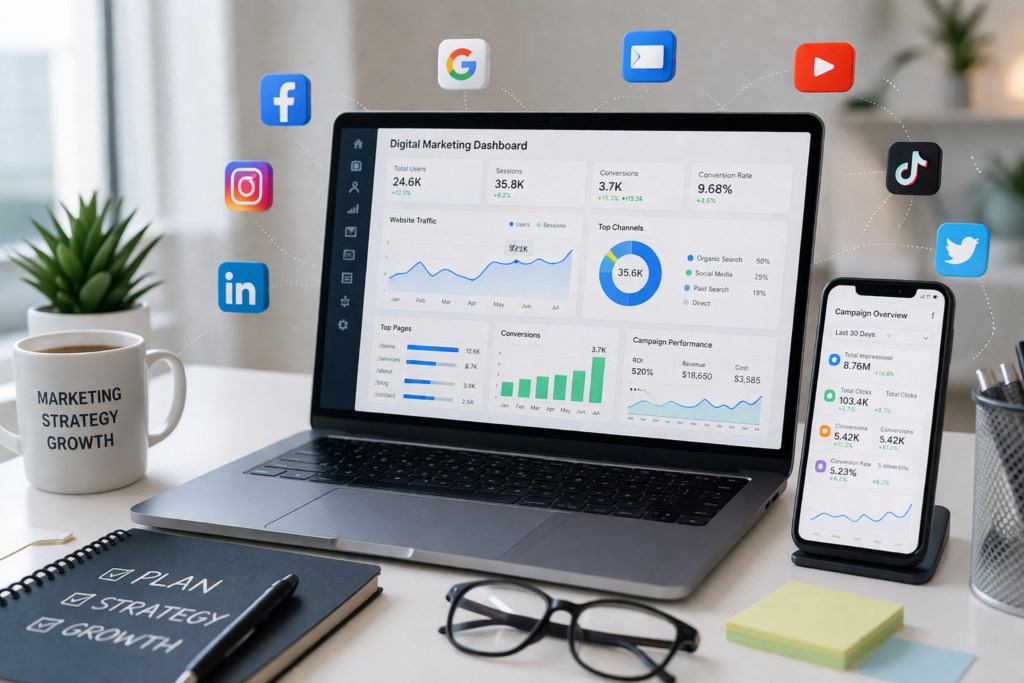
You’ve probably heard the term everywhere—on YouTube, in business meetings, and across social media platforms—but what is digital marketing, really?
In simple words, digital marketing is the process of promoting a business, product, or service using the internet. However, beyond that definition, digital marketing is about reaching the right people at the right time, and nowadays, that time is online.
Think about your everyday life for a moment. You scroll through Instagram, search on Google, watch videos, or read blogs. Now imagine a business trying to reach you.
Even when you travel, you still see billboards, which are big and visible. But how often do they actually influence your decision? More importantly, are they reaching the right person at the right moment?
Now compare that to finding exactly what you need through a search or discovering a product while scrolling online. That’s the difference. One is just seen. The other is relevant and effective.
Digital marketing is not just about tools or trends. It’s about understanding people, their habits, needs, and behaviours, and showing them where they already are.
Everything else like SEO, social media, email marketing, content and Google Ads, is simply a way to connect, engage, and convert.
What digital marketing really means
At first, digital marketing can feel like a collection of tools. SEO, social media, ads, emails, and content. It looks like a checklist of things you’re supposed to do.
That’s exactly how I saw it in the beginning.
Post regularly. Try different platforms. Run ads. Write blogs. It felt like I was doing everything, but nothing really clicked. The effort was there, but the connection wasn’t.
Then something shifted.
Instead of asking “What should I post next?”, I started asking “Who am I trying to reach?”
That one question changed everything.
I began noticing patterns. What people were searching for. What they were struggling with. What kind of content made them stop scrolling. And slowly, digital marketing stopped feeling like a task… and started making sense.
Because digital marketing is not really about platforms or tools.
It’s about people.
It’s about understanding their habits, their needs, their behavior, and showing up in those exact moments with something useful, relevant, or meaningful.
Think about it. When you search for something online, you’re not looking for an ad. You’re looking for an answer. When you scroll through social media, you don’t stop noise. You stop for something that connects.
That’s what digital marketing is really about.
In simple terms, digital marketing is about showing up at the right time, with the right message, for the right person.
And when that happens, it doesn’t feel like marketing anymore.
It feels natural.
Why Digital Marketing Matters
Digital marketing is no longer optional. It’s essential for all kinds of businesses.
Think about how people live today. From the moment they wake up to the time they go to sleep, they’re online searching, scrolling, watching, and exploring. Your audience is active 24/7, and digital marketing ensures your business shows up exactly when it matters.
One of the biggest advantages is reach. Time and location do not restrict you.
Whether it’s morning or midnight, your brand can connect with people anytime.
It’s also cost-effective. Unlike traditional marketing, where costs can quickly go high, digital marketing allows even small businesses to compete and grow with the right strategy. It’s not about spending more, but about spending smarter.
Another powerful aspect is measurability. Every click, view, and conversion tells a story. You’re no longer guessing what works. You can see real data, understand behaviours, and continuously improve your approach.
Over time, trust is built. Through consistent content, emails, social media posts, and videos, your audience starts to recognize you.
What begins as a simple interaction gradually turns into a relationship, and eventually, loyalty.
Then comes flexibility. Markets change, trends shift, and audience behavior evolves. Digital marketing allows you to adapt quickly, test new ideas, adjust campaigns, and improve results in real time.
In simple terms, digital marketing is not just about promoting your business.
It is about growing your brand, generating leads, and building lasting connections while staying measurable, flexible, and cost-effective.
How Digital Marketing Works
Digital marketing might seem complex from the outside, but at its core, it follows a simple and logical process.
It started with a simple question: why isn’t this reaching people?
That’s when I understood that it always begins with understanding people.
First, you identify your audience. Who are they? What do they need? What problems are they trying to solve? Are they searching on Google, scrolling through social media, or watching videos?
When I started paying attention to this, things became clearer. The better you understand behaviour, the more effective your marketing becomes.
Next comes choosing the right channels. Initially, there’s a temptation to be everywhere. But that doesn’t work. I learned that not every platform matters equally. What matters is where your audience actually spends time.
Search engines help you reach people actively looking for solutions.
Social media helps build awareness and engagement.
Email marketing nurtures relationships and drives repeat business.
Video platforms help you educate, tell stories, and build authority
Concentrating on the right channels were more impactful than attempting to tackle everything simultaneously.
Once that was clear, content became the connection. Content is what people see, read, and interact with. At first, it’s easy to think content is just about posting. But over time, I realised it needs to solve something, add value, or create a connection. A blog, a video, a simple post — each one plays a role in building trust.
But creating content alone wasn’t enough.
It needed visibility.
That’s where promotion comes in. Through SEO, social media, and ads, your content starts reaching the right people. This is where the process begins to take shape. You begin to see what works, what doesn’t, and what needs improvement. Slowly, you start optimising — refining your approach instead of guessing.
Finally, everything is measured and scaled. One of the biggest shifts for me was seeing actual data. Engagement, clicks, and conversions— they tell you a story. When something works, you don’t stop there. You scale it, reach more people, and build on it.
Over time, this process creates something powerful.
Your brand becomes visible.
People start recognising you.
Trust begins to build.
And growth becomes consistent, not random.
At its core, digital marketing is simple.
Understand people, show up with value, and keep improving.
That’s what makes it work.
Importance of Digital Marketing
Understanding what is digital marketing helps you see how businesses attract, engage, and convert customers online. It is not just about promotion; it is about making your business visible, building trust, and achieving consistent growth.
Today, when people need something, they search online first. If your business is not visible at that moment, you are missing real opportunities. Digital marketing ensures that your business appears where your target audience is already active, such as on social media, search engines, and other online platforms.
This visibility is what keeps leads and enquiries coming in.
At the same time, customers do not make decisions immediately. They explore, compare, check reviews, and return before making a choice. A strong online presence helps your brand stay in front of them throughout this process, building trust over time.
Why Digital Marketing Matters
A well-planned strategy helps your business in many ways:
- Improves visibility by showing up in search results and online platforms
- Builds brand awareness through consistent presence
- Reaches the right audience instead of a mass audience
- Attracts potential customers from people already interested
- Supports long-term growth with continuous online presence
Over time, something else starts to happen beyond just visibility.
People begin to trust you.
Not because you’re constantly promoting, but because you’re consistently showing up with something useful. A helpful post, an answer to a real question and a piece of content that solves a problem to build credibility. And slowly, your audience starts to see you as someone who knows what they’re talking about.
Then comes one of the biggest advantages of digital marketing — clarity.
Unlike traditional methods that leave you guessing, digital marketing allows you to see what’s happening. You can understand how people interact with your content, what they click on what they ignore and what drives action. That insight changes everything. It helps you make better decisions, refine your approach, and improve results over time.
And there’s one more thing that makes a huge difference.
You’re not limited to location anymore.
Your business is no longer tied to a single place or a fixed audience. With the right strategy, you can reach people across cities, countries, or even globally. You can run your presence continuously, grow steadily, and scale in a way that wasn’t possible before.
That’s the real shift digital marketing brings to your business.
It’s not just about being seen.
It’s about being trusted, understood, and able to grow without limits.
The Bigger Impact
Eventually, the importance of digital marketing comes down to one thing which is connection. Targeting the right audience at the right time builds trust in your business.
It’s not just a marketing process anymore. It’s a key part of how businesses grow, compete, and stay appropriate today.
The Process Behind Digital Marketing
Digital marketing is the process of connecting your business with the right people online, guiding them from awareness to action.
It doesn’t happen in one step. Digital marketing works as a system where different channels and strategies come together to attract, engage, and convert target customers.
Digital marketing ensures your business is visible and relevant to people who are searching for a service, scrolling through social media, or reading online content.
The user is gradually drawn into action, can establish trust, and takes the necessary steps to engage in activity, such as contacting you or purchasing something.
How the Process Actually Works
In simple terms, digital marketing follows a well-organised process:
- Attract attention through search engines, social media, or ads.
- Attract users with useful content or relevant messaging.
- Build trust by providing value and consistency.
- Convert leads to customers through clear calls-to-action.
This journey is what turns a random visitor into a potential client.
Important Factors
A variety of elements support every step in the digital marketing process, ensuring its effectiveness.
1. Visibility (Showing up in searches)
Your business needs to appear where people are searching. This is done through search engine optimization (SEO), social media presence, and paid ads. Without visibility, nothing else works.
2. Content (Creating Value)
Once people online find you, content plays a major role. Blogs, website pages, and social posts help explain your services, answer questions, and keep users engaged.
3. Targeting (Reaching the Right People)
Instead of showing your content to everyone, digital marketing focuses on people who are more likely to be interested. This improves efficiency and results.
4. Conversion (Turning Visitors into Leads)
After building trust, the next step is action. This can be:
- Filling out a form
- Booking a service
- Contacting you
A clear and simple user journey is what drives conversions.
Why This Process Works So Effectively
The strength of digital marketing depends on how everything works together. Each step supports the next, creating a continuous cycle of growth.
Unlike random promotion, digital marketing:
- Reaches people at the right time
- Builds trust before selling
- Improves based on real data
- Creates long-term visibility
Beyond marketing, it becomes a mechanism for continuous business expansion.
Key Conclusion
In the real world, digital marketing works by helping your audience move forward through a journey — from discovering your business to trusting it and finally choosing it.
When done correctly, it doesn’t feel like selling. It feels like helping the right people find exactly what they need at the right time.
Traditional Marketing vs Digital Marketing
Traditional marketing includes methods like newspapers, television ads, radio, and billboards. These approaches were effective for a long time because they helped businesses reach a wide audience. However, they generally work in one direction — businesses send a message, and people receive it without much interaction.
Digital marketing has changed completely. Businesses can now connect, engage, and build relationships with their audience online instead of just sending a message to a large group of people.
When you look at digital marketing, it becomes clear that it is not just about promotion — it’s about reaching the right people and influencing their decisions in a more direct and measurable way.
How they differ in real situations
Although it focuses on promotion, conventional marketing often lacks precision. While advertising in a TV commercial or newspaper can be effective for many people, it may not always be the most popular form of marketing.
On the other hand, digital marketing allows businesses to target specific users based on their behaviour, interests, and what users are looking for. This makes marketing efforts more relevant and effective.
Another important difference is interaction. Traditional marketing rarely allows direct engagement, while digital platforms enable businesses to communicate with their audience instantly through comments, messages, and content.
Main differences
The difference becomes clearer when you compare how both practices perform in real situations:
- Reach: Traditional marketing is usually limited to a specific area, while digital marketing can reach audiences globally.
- Targeting: Digital marketing focuses on people who are more likely to be interested, instead of a wide audience.
- Engagement: Traditional methods are one-way, while digital marketing allows ongoing communication.
- Measurability: Results from traditional campaigns are difficult to track, whereas digital marketing provides clear performance data.
- Flexibility: Digital campaigns can be adjusted quickly, while traditional campaigns are harder to change once launched.
Why Businesses Are Shifting Online
Customer behaviour has changed significantly. Today, people search online, compare options, read reviews, and then make decisions.
This is where digital marketing becomes powerful — it helps businesses stay present throughout this entire journey. Instead of waiting for customers to notice them, businesses can actively appear where decisions are being made.
The main benefit
The biggest advantage lies in control and clarity.
By utilising digital marketing, businesses can track what works, understand their audience better, and improve their strategy continuously. Every click, visit, or inquiry provides useful information that helps in making smarter decisions.
Traditional marketing is unable to provide such insight.
Final Insight
Traditional marketing helps build awareness, but digital marketing prioritises action and delivers clear results.
Understanding digital marketing enables businesses to prioritise it over other methods because it is more targeted, interactive, and reflective.
The need for digital marketing is no longer an option for any business — it is a necessary part of staying competitive and relevant.
ServicesTypes of Digital Marketing
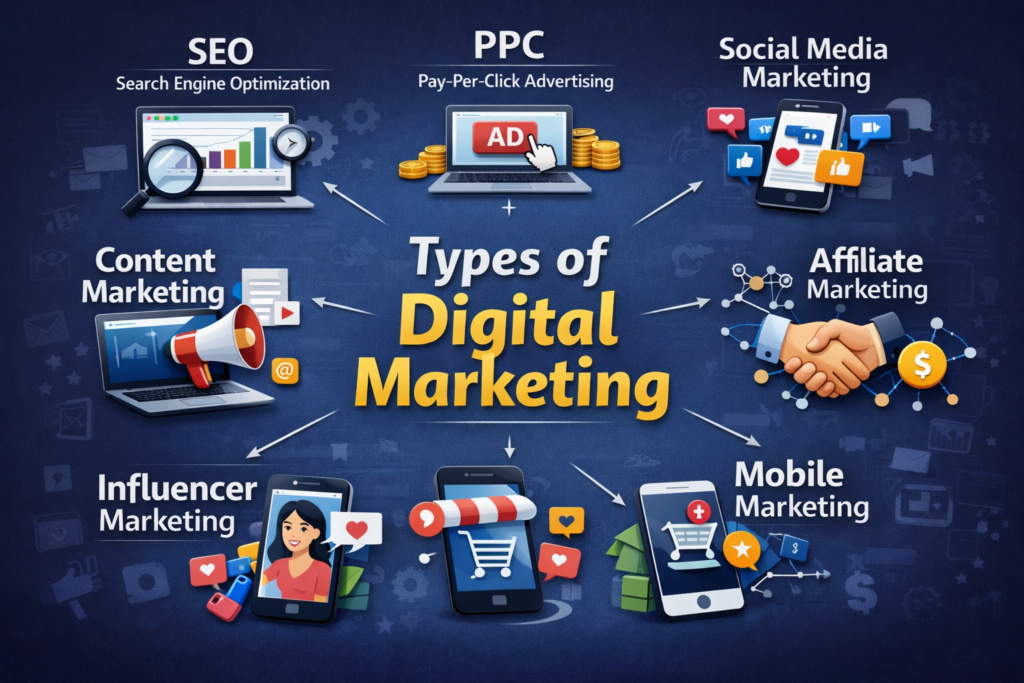
In today’s online world, understanding the types of digital marketing is essential for any business that wants to grow, attract customers, and stay competitive. Whether you’re a startup, freelancer, or established brand, digital marketing gives you multiple ways to reach your audience online.
But not all strategies work the same way. Each type works as a different purpose and knowing when and how to use them can make a huge difference in your results.
1. Search Engine Optimization (SEO)
SEO is one of the most powerful types of digital marketing because it mainly focuses on long-term visibility. If you’re wondering what is digital marketing, SEO plays a key role by helping your website rank higher on search engines like Google when users search for relevant keywords.
Instead of paying for website visitors, you earn traffic organically by optimizing your website content, using the right keywords, and improving website speed and user experience.
For example, if someone searches “digital marketing freelancer,” a well-optimized site can appear on the first page and bring in consistent leads without continuous ad investment.
2. Pay-Per-Click Advertising (PPC)
PPC gives instant results. You run ads and pay only when someone clicks on them.
This type of digital marketing works well when you need:
- Instant visitors
- Quick conversions
- Reaching the right audience
Platforms like Google Ads and social media ads allow you to target users based on location, interest, and behaviour. Spending should be balanced with performance to avoid high costs
3. Social Media Marketing
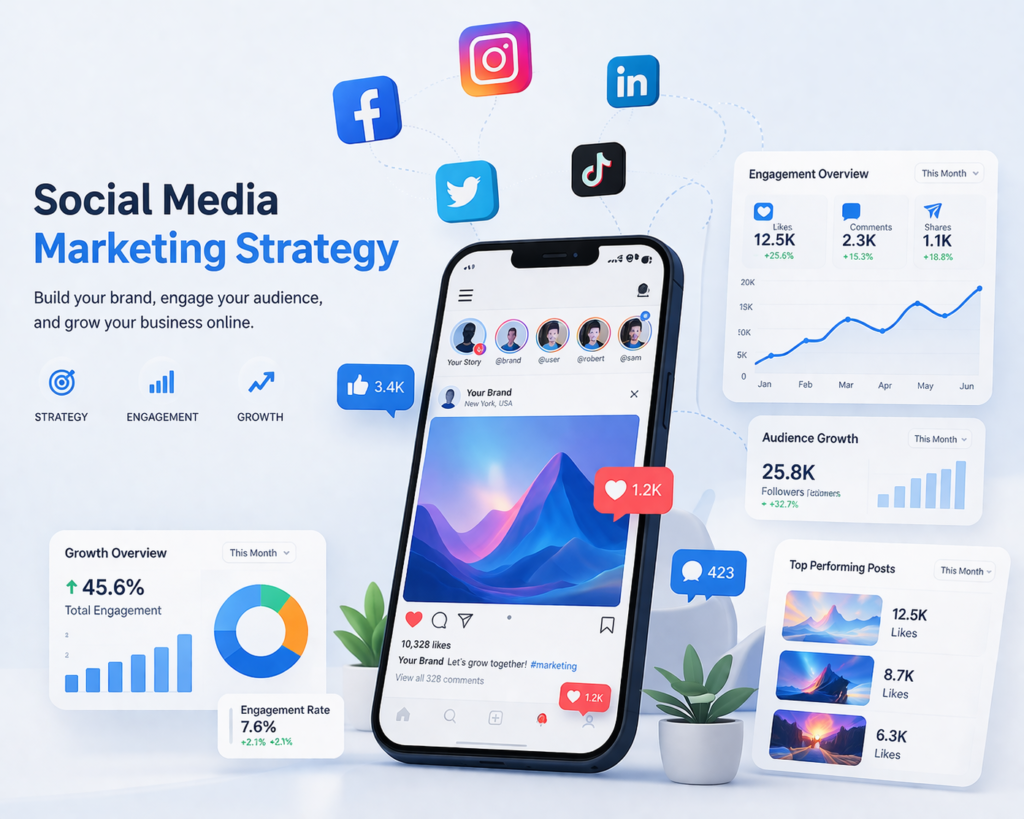
Social media is where brands build personality and connect directly with their audience. This is one of the most engaging types of digital marketing because it allows two-way communication.
It includes:
- Posting content (reels, images, carousels)
- Running paid campaigns
- Engaging with comments and messages
Platforms like Instagram, LinkedIn, and Facebook are especially powerful for brand awareness and trust-building.
4. Content Marketing
Content marketing focuses on creating valuable content that educates, informs, or solves problems.
This includes:
- Blog posts
- Videos
- Guides and eBooks.
Among all types of digital marketing, this one build authority gradually. Instead of directly selling, you provide value — and that builds trust, which ultimately leads to conversions.
5. Email Marketing
Email marketing is often less recognized, but it delivers one of the highest returns on investment.
It helps you:
- Stay connected with your audience
- Engage potential customers
- Promote services or offers
You own your email list. That makes this type of digital marketing more reliable for long-term communication.
6. Affiliate Marketing
Affiliate marketing involves partnering with others who promote your product or service and earn a commission for each sale.
This type of digital marketing works well because:
- You only pay for results
- It expands your reach through others’ audiences
It’s commonly used in e-commerce and digital services.
7. Influencer Marketing
Influencer marketing makes use of people who already have an audience and trust in a specific niche.
Instead of promoting yourself, you collaborate with influencers who recommend your brand. These methods build trust faster than traditional ads.
Among modern types of digital marketing, this approach is especially effective for:
- Fashion
- Lifestyle
- Tech products
8. Mobile Marketing
With most users browsing on phones, mobile marketing has become essential.
It includes:
- SMS marketing
- App-based notifications
- Mobile-friendly websites
This type of digital marketing ensures your audience has a smooth experience regardless of device.
How to Choose the Right Type of Digital Marketing
Not every strategy works for every business. The right mix depends on your goals:
- Want long-term growth → Focus on SEO and content
- Need quick leads → Use PPC
- Want engagement → Go for social media
- Want customer retention → Invest in email marketing
The best results usually come from combining multiple types of digital marketing rather than relying on just one.
Each method plays a role in building visibility, trust, and conversions. Digital marketing varies by business, but when done right, it’s a powerful growth tool.
Digital Marketing Examples
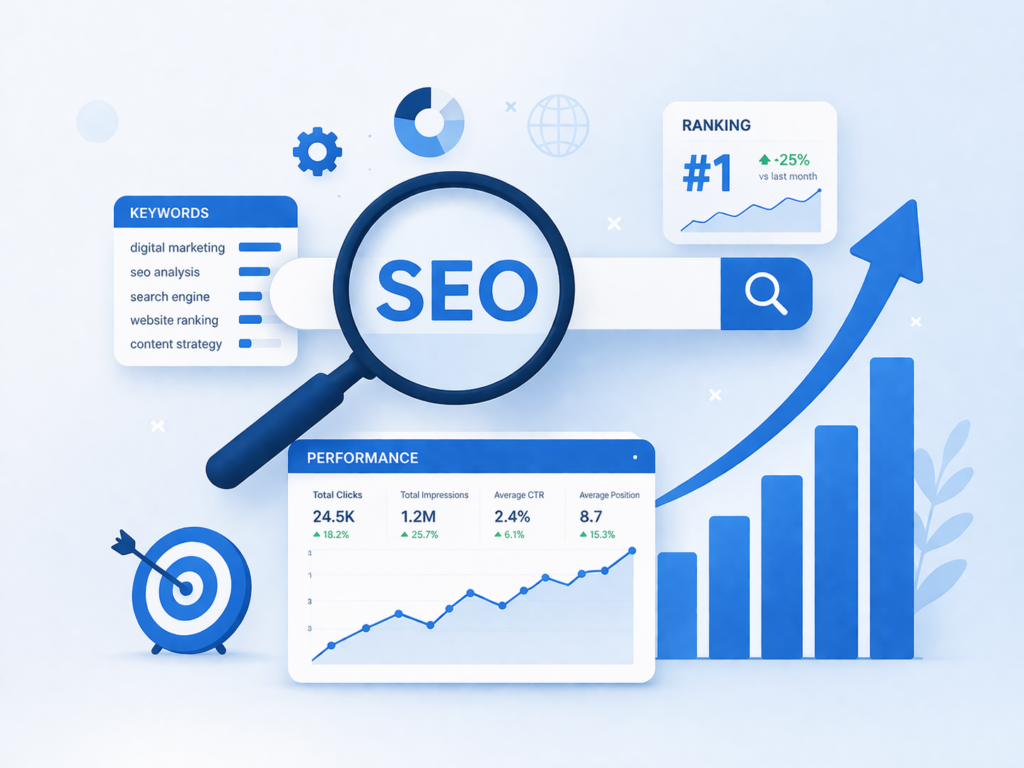
Digital Marketing Examples: Real Case Studies with Problems, Strategies & Results
For a better understanding of what is digital marketing, let’s look at how real brands use it.
When businesses look at digital marketing examples, the real question is not “What did they do?” — it’s “What problem were they solving, and how did digital marketing help them grow?”
Every successful campaign starts with a challenge. Growth happens when the right strategy solves that challenge effectively.
The distinction between average and high-performing marketing frequently hinges on execution.
The following case studies go beyond surface-level strategies and show how brands used digital marketing in a way that directly impacted their growth.
Airbnb: Engineering Organic Growth Through Search Intent
In its early days, Airbnb faced a simple but serious problem of not having enough people searching for them.
The target was hotels, not apartments. And even if they found Airbnb, there was hesitation. Staying in a stranger’s home didn’t feel safe or familiar.
Airbnb chose to avoid advertising and instead focused on promoting its brand. They asked, ‘What are people already searching for?’
That question changed everything.
They began building pages around real search intent—places to stay in specific cities, neighborhoods, and travel situations. Every host’s listing became more than just an option on their platform; it became a searchable entry point into their ecosystem.
Airbnb slowly emerged and appeared in the exact spot where users were already searching.
But visibility alone wasn’t enough. Trust had to be established right after users stepped onto the site. The main areas of focus for Airbnb were visuals, reviews, and verification. Genuine pictures, genuine encounters; and real people.
Over time, something powerful happened. Users didn’t just visit Airbnb — they trusted it. What started as a visibility problem turned into a scalable growth engine. And today, Airbnb dominates search results in travel categories worldwide.
This digital marketing example showcased the importance of human behaviour in achieving success through traffic alignment.
Zomato: Becoming Part of Everyday Conversation
Zomato wasn’t struggling with awareness. People knew the brand. But there was a gap — people weren’t engaging.
Their social media felt too promotional, and users are quick to ignore anything that looks like an ad.
Zomato realised a simple but powerful truth: people don’t open Instagram to see promotions — they open it to feel something.
So, they stopped selling.
Instead, they started posting content that felt like everyday life. Late-night hunger jokes. Office lunch memes. Relatable moments that didn’t ask for anything in return.
At first, it just got a few laughs. Then share. Then have conversations.
And slowly, Zomato became more than a food delivery app — it became a brand people enjoyed seeing in their feed.
What changed wasn’t just content, but perception. When users eventually felt hungry, they didn’t need to be convinced. Zomato was already in their mind.
Among all digital marketing examples, these show how growth often starts with attention, not conversion.
Nike: Selling a Feeling, not a Product
Nike had no shortage of competition. The market was crowded, and many brands offered similar products.
Therefore, Nike made a shift. Instead of competing on features, they chose to compete on meaning.
Their campaigns stopped being about shoes. They became about people – their struggles, ambitions, and victories.
Through digital platforms, Nike told stories. Stories of athletes overcoming obstacles. Stories of ordinary people doing extraordinary things and being successful.
And something clicked.
People didn’t just see Nike products — they saw themselves in those stories.
This emotional connection created something deeper than just a sale. It built loyalty.
Over time, Nike wasn’t just a brand. It became a brand you identify with.
This is one of the most powerful digital marketing examples because it proves that when people feel connected, they don’t compare, but they choose.
HubSpot: Teaching Before Selling
HubSpot faced a different kind of challenge.
They weren’t just selling a product — they were introducing a concept. Many businesses didn’t fully understand digital marketing or why they needed tools like HubSpot.
So instead of pushing the sales, they decided to teach.
They started answering a lot of questions. Writing blogs. Creating free courses. Giving away templates.
At first, it didn’t look like marketing at all. It looked more like an education.
But that was the strategy. As more people started searching for answers, they kept finding HubSpot. Again and again.
Over time, users naturally built trust, and by the time they were ready to invest in a tool, they had already made their decision.
HubSpot didn’t chase customers; they prepared them.
This is one of those digital marketing examples that shows how patience and value creation lead to long-term growth.
Dollar Shave Club: One Video That Changed Everything
Dollar Shave Club entered a market where giants already dominated shelf space, advertising, and customer trust. Brands were spending millions to convince people that razors needed to be premium, complex, and expensive.
For a new company with limited resources, competing on the same terms was almost impossible.
Rather than competing with bigger budgets, Dollar Shave Club focused on smarter ideas.
They approached the market from the customer’s point of view. The real problem wasn’t a lack of options — it was high prices and unnecessary complexity.
Razor prices had increased without clear justification.
So, they built their entire message around one simple idea: good razors don’t need to be expensive.
Their launch video reflected this clarity. It didn’t rely on high production or cinematic visuals. Instead, they used humour, honesty, and direct communication to break through the noise.
The founder spoke directly to viewers, explaining the problem and the solution in a simple, natural way. This immediately built trust.
But what truly made the video powerful was its shareability. It wasn’t just informative — it was entertaining. People shared it because it made them laugh and because it felt different from traditional ads.
Within days, the brand experienced a surge in traffic and subscriptions. The video didn’t just generate awareness — it created immediate action.
The deeper lesson from this digital marketing example is simple but powerful: clarity drives growth.
When your message is clear, relatable, and easy to understand, people don’t just consume it — they share it. Your audience becomes your distribution channel. Instead of pushing your message harder, you make it easier for others to carry it forward.
Dollar Shave Club didn’t win because it spent more. It won because people instantly understood what it offered and why it mattered.
There was no confusion or unnecessary messaging — just a clear link between the problem and the solution.
That’s what made the difference.
In digital marketing, clarity is not just a communication skill — it’s a growth strategy.
Amazon: Solving Conversion and Retention at Scale
Amazon faced a very different challenge. Unlike new brands, Amazon already had massive traffic. The question wasn’t about how to get users — it was about how to convert and retain them efficiently.
At that scale, even small improvements in user experience could lead to a huge revenue impact.
Amazon realised that having too many options can make decisions harder for customers.
Instead of showing more products, Amazon focused on making decisions easier.
They began analysing user behaviour at a deeper level— what people search, what they click, what they ignore, and what they eventually buy. This data allowed them to predict intent with surprising accuracy.
That’s why when you visit Amazon, it doesn’t feel random. The homepage, recommendations, and even emails feel relevant.
This is not accidental. It’s a system designed to guide decisions.
For example, features like “Frequently Bought Together” or “Customers Also Viewed” subtly reduce the need for comparison. The platform does the thinking for the user.
Over time, this creates a powerful effect. Users trust the platform to help them choose.
And when trust increases, hesitation decreases.
This is what makes Amazon so effective — marketing is no longer separate from the product. It becomes part of the experience itself.
You’re not being influenced. You’re being assisted.
These digital marketing examples go beyond campaigns and channels. They reveal something more fundamental—that growth comes from understanding human behaviour.
Dollar Shave Club understood frustration and simplified it.
Amazon understood decision fatigue and reduced it.
Different problems, different strategies — but the same principle: remove friction for the user.
This is where most businesses struggle. They focus too much on visibility and not enough on experience. But getting attention is only half the job. What happens next is what defines success.
The strongest takeaway from these case studies is that effective marketing doesn’t feel like marketing.
It feels like:
- Clarity instead of confusion
- Help instead of pressure
- Relevance instead of noise
If you’re building your brand or working with clients, this is the shift that matters. Don’t just ask how to promote something — ask how to make the decision easier for the user.
In the long run, brands that grow aren’t the loudest — they’re the ones people understand instantly.
Benefits of Digital Marketing
In a constantly evolving digital world, traditional marketing alone is no longer enough. Businesses need a smarter, more measurable, and cost-effective approach — that’s where digital marketing comes in.
Compared to traditional marketing, digital marketing lets you reach your audience directly, measure performance instantly, and target the right people more accurately.
1. Wider Reach and Global Audience
One of the most significant benefits of digital marketing is the ability to reach a vast audience. With tools like social media, search engines, and email campaigns, businesses are no longer limited by geography.
A small brand can now connect with potential customers across cities, countries, or even continents. This reach is nearly impossible with traditional marketing methods.
2. Cost-Effective and Measurable
Digital marketing provides measurable results that help businesses understand what is working and what isn’t. Pay-per-click campaigns, social media ads, and email marketing allow brands to spend efficiently, targeting only those most likely to convert.
Unlike expensive print ads or TV commercials, digital campaigns can start with minimal budgets and scale as results improve.
3. Targeted and Personalized Marketing
Consumers today prefer relevant experiences, and digital marketing makes it possible to target audiences based on specific characteristics and past engagement.
This targeting ensures that your message reaches the right people at the right time, improving engagement and conversion rates.
4. Real-Time Performance Tracking
Every digital marketing campaign comes with built-in analytics. You can track impressions, clicks, conversions, and other important metrics instantly.
This real-time insight helps businesses make data-driven decisions, refine strategies, and improve ROI — something traditional marketing rarely offers with such precision.
5. Builds Brand Awareness and Credibility
Consistent online presence across websites, social media, and search engines strengthens brand visibility. Additionally, quality content, reviews, and engagement contribute to credibility. Customers are more likely to trust a brand they find actively sharing valuable information online.
6. Flexibility and Adaptability
Digital marketing campaigns are highly flexible. Businesses can test different strategies, tweak messaging, or adjust targeting mid-campaign to achieve better results. This adaptability ensures that marketing efforts remain effective even as trends or customer behaviours change.
7. Higher Engagement and Customer Interaction
Unlike traditional marketing, digital marketing encourages interaction. Through social media comments, emails, or live chats, businesses can engage directly with customers, answer questions, and build relationships.
This interaction not only increases sales but also strengthens customer loyalty and long-term retention.
The Bottom Line
Investing in digital marketing is no longer optional — it’s essential for any business aiming to grow in a competitive market. Its ability to reach a wider audience, provide measurable results, and create meaningful customer engagement makes it one of the most powerful tools in modern business strategy.
Whether you’re a small startup or an established company, the benefits of digital marketing are clear: smarter campaigns, better ROI, and stronger connections with your customers.
Challenges in Digital Marketing
1. Constantly Evolving Trends and Technology
One of the biggest challenges in digital marketing is keeping up with rapidly changing trends and technology. Platforms like Google, Facebook, and Instagram regularly update algorithms, tools, and features.
What works today in marketing may not work tomorrow, making continuous learning and adaptation essential.
2. High Competition and Saturation
With digital marketing, it has become easier for businesses of all sizes to compete online. This has made the online marketplace extremely competitive.
Differentiating your brand in a crowded market requires creativity, strong branding, and consistent audience engagement.
3. Data Overload and Analysis Complexity
With every click, view, and interaction generating data, marketers have access to more information than ever before. While data-driven marketing is powerful, managing and analysing large datasets to make informed decisions can be overwhelming.
Choosing the right metrics to track and act upon is a constant challenge in digital marketing.
4. Targeting the Right Audience
Effective marketing isn’t about reaching everyone; it’s about reaching the right people. Identifying, segmenting, and targeting your ideal audience requires research, testing, and ongoing refinement.
When campaigns are not aligned with the audience, they often lead to unnecessary costs and limited results.
5. Maintaining Consistency Across Channels
With multiple platforms available—social media, email, blogs, and paid ads— keeping your messaging consistent is challenging. Inconsistent branding or messaging can confuse potential customers and weaken the impact of your digital marketing efforts.
6. Measuring ROI Accurately
While digital marketing provides measurable data, calculating true ROI can be complex. From attributing conversions to understanding long-term customer value, marketers often struggle to quantify how specific campaigns directly affect revenue.
Final Thoughts
While challenges in digital marketing are real, they are not insurmountable. Staying updated with trends, making use of analytics wisely, and maintaining a focused, adaptable strategy can help businesses overcome these hurdles.
Conclusion
Digital marketing doesn’t have to be confusing or expensive. If you’re wondering what is digital marketing, it is simply about clarity, focus, and consistency. It means knowing who your audience is, choosing the right channels, and delivering content that is valuable.
Begin with the most important aspects. Focus on a couple of channels, experiment with one or two strategies, and learn from the results. Progress in digital marketing comes from steady and intentional action, not from trying every new tool or trend at once.
The true strength of digital marketing comes from understanding your audience and adjusting your strategy using data and feedback. Even small but consistent actions like publishing a blog post, sharing a short video, or sending an email campaign can produce meaningful results over time.
Take a small step today by trying out a single strategy. The best lessons come from doing, not just planning.
Observe your audience’s responses, refine your approach based on your learnings, and don’t hesitate to share insights or ask questions. This is the key to confidently growing in the dynamic world of digital marketing..
Found this helpful? Explore more insights and take your digital marketing to the next level.https://www.oracle.com/in/cx/marketing/digital-marketing/
FAQs
1: What is digital marketing in short answer?
Digital marketing promotes products or services online using channels like social media, websites, emails, and search engines to reach and engage your audience effectively.
2: Which skill is most demanding in digital marketing?
Skills like SEO, content creation, data analytics, and social media management are highly in demand, as they directly impact visibility, engagement, and conversions.
3: What skills are required for digital marketing?
Key skills include SEO, content marketing, social media strategy, email marketing, analytics, paid advertising, and basic design or video editing abilities.
4: What is the scope of digital marketing?
Digital marketing offers vast opportunities across industries, helping businesses reach global audiences, generate leads, build brand presence, and drive measurable growth.